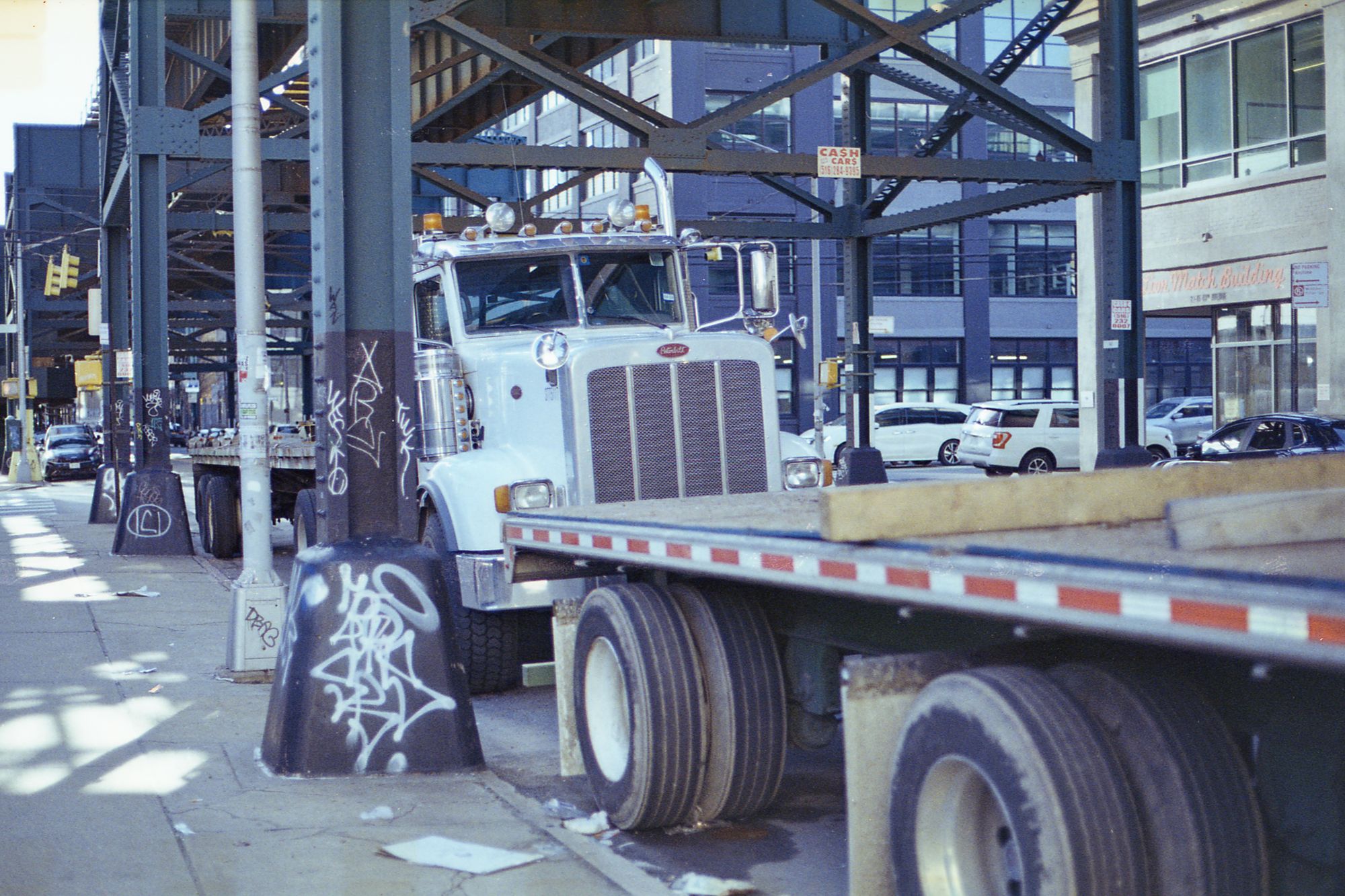
Flatbed. Sequenced.
Crane-Ready.
On Site.
The right materials, in the right sequence, to a job site that may have 20 minutes of crane time and a mud road for access — that’s what we plan for.
Five loads. Five windows.
One flawless build sequence.
Construction logistics lives or dies by sequencing. We stage, hold, and release each load against your build calendar — so every delivery lands crane-ready, in the exact order your site superintendent needs it.
- 1D–5
Site Survey
Access brief, crane window, turning radius confirmed with superintendent
- 2D–2
Foundation Steel
Structural beams & anchor bolts — crane-sorted, chains & binders photographed
- 3D–0 07:00
Framing Lumber
Conestoga trailer — weather-protected, graded bundles in install order
- 4D+3
Drywall & Panels
Step-deck flatbed — sequenced after rough electrical, before finish trades
- 5D+7
Pre-Fab Module
Oversize permit filed, pilot car coordinated — crane-ready arrival to the minute
Our dispatch system flags loads at risk of arriving out of sequence 48–72 hours in advance — so we adjust before a load ships, not after it arrives.
Five challenges that stall
generalist freight brokers.
Job-Site Access Constraints
Active construction sites are cramped by design. A 53-foot flatbed may not be able to manoeuvre into the unloading zone without a spotter and a specific approach angle. Some sites are accessible only by straight truck. Others have overhead obstructions (power lines, scaffolding), soft ground requiring outrigger pads, or a single shared entry/exit lane that must be coordinated with other deliveries. A driver who arrives without a site-specific access briefing will either fail the delivery or damage equipment.
Sequenced Delivery & Just-in-Time Materials
On large commercial or industrial construction projects, materials must arrive in the order they’re installed — not in the order they were manufactured or shipped. Delivering trusses before the walls are framed means the general contractor has no place to put them and the load blocks other deliveries. Sequenced delivery requires active coordination with the site superintendent, a clear understanding of the build schedule and the logistics partner’s ability to hold and release loads against that schedule.
Cargo Securement for Open-Deck Loads
Building materials on flatbed require specific securement under FMCSA 49 CFR Part 393: lumber bundles need a minimum number of tie-downs based on length and weight; coiled steel requires chocks and chains; drywall must be blocked and strapped to prevent shifting. Improper securement is the leading cause of cargo claims on flatbed construction loads, and an out-of-service securement violation shuts down a delivery mid-route.
Oversize Pre-Fabricated Modules & Panels
Modular construction has accelerated the shipment of pre-fabricated wall panels, bathroom pods and structural modules that are too wide or tall for a standard flatbed lane. These loads require oversize permits, step-deck or double-drop equipment for height clearance, and coordination with the general contractor’s crane operator for a precise delivery window. Modules often cannot be stored at the site; the crane must be ready when the truck arrives.
Weather Sensitivity & Supplier Lead-Time Variability
Lumber, drywall and roofing materials are weather-sensitive: a load of open-deck lumber caught in heavy rain without adequate tarping can warp or swell, rendering it unusable on a finish-grade application. Simultaneously, mill and manufacturing lead times fluctuate with demand surges. A logistics partner needs to monitor supplier release dates and tarp or tarpaulin-wrap shipments when weather is a risk.
Five capabilities. One construction desk.
- 01
Site Survey & Access Planning
Before the first load moves, our construction team contacts the site superintendent to collect access road specifications, turning radius constraints, overhead clearances, unloading zone dimensions and crane windows. This information goes into a site delivery brief that every assigned driver receives before pickup, eliminating the ‘surprised driver at the gate’ scenario.
- 02
Sequenced Delivery Scheduling
We work directly from your project schedule or the general contractor’s procurement calendar to build a delivery sequence. Loads are staged at origin, held in a nearby yard, or consolidated at a transloading facility and released to the site in the order materials are needed. Our dispatch system flags loads that are at risk of arriving out of sequence and surfaces alternatives before the gap occurs.
- 03
Flatbed & Open-Deck Equipment Matching
Standard flatbed, step-deck, double-drop, Conestoga (roll-tite) and RGN are all available through our vetted carrier network. For lumber and drywall we specify Conestoga trailers for weather protection where the shipper requires it. For structural steel and oversize panels we match trailer configuration to load dimensions and confirm against permit corridor requirements before the truck is dispatched.
- 04
Oversize Permit Filing & Escort Coordination
Pre-fab modules and long structural members regularly exceed legal width or height limits. Qeep files oversize permits in-house across all 48 contiguous states and Canadian provinces. For building materials moves requiring escort vehicles, we coordinate pilot cars and confirm travel-time windows (many states restrict oversized loads to daylight hours) against the site’s crane schedule.
- 05
FMCSA Securement Compliance & Load Documentation
Our carrier onboarding includes securement standards specific to construction commodities: tie-down count and placement for lumber bundles, chain-and-binder requirements for steel, blocking specifications for drywall. Every load is photographed at origin (loaded and secured) and those photos are attached to the delivery record. Securement violations are a carrier performance metric we track and enforce.

Lumber that arrives out of sequence doesn't just sit — it blocks the crane, idles the crew, and costs real money.
Every load we move is staged and released to match your build calendar — not ours.
The rules governing
construction freight.
FMCSA Cargo Securement Standards (49 CFR Part 393, Subpart I)
Federal rules specify minimum working load limits for tie-downs, the number of tie-downs required per load length and weight, and blocking/bracing requirements for specific commodity types. For lumber, at least one tie-down per 10 feet of load length is required; for steel coils, minimum securement includes chocks and/or cradles plus chains. Non-compliant loads face out-of-service orders and liability for any resulting accident.
State & Provincial Oversize / Overweight Permits
Pre-fabricated modules, long trusses, wide wall panels and structural steel beams regularly exceed legal-load dimensions. Every state and province has its own permit application, fee and routing approval process. Some jurisdictions require a certified route survey before issuing a permit for loads over certain thresholds. Qeep files permits in-house, tracks expiry windows and maintains routing contingencies.
WSIB / Workers’ Compensation & Site Clearances (Canada)
In Ontario and most Canadian provinces, carriers making deliveries to active construction sites must confirm that their drivers are registered with the provincial workers’ compensation board (WSIB in Ontario) and that the carrier holds applicable workplace insurance clearance certificates. General contractors frequently require clearance certificates before allowing a truck onto the site.
OSHA Construction Zone & Site Safety (29 CFR Part 1926)
US construction site delivery drivers must comply with OSHA Part 1926 requirements for construction zone safety, including PPE (hard hat, hi-vis vest, safety footwear) and flagging/spotting protocols when reversing in active work zones. Qeep’s carrier compliance program includes site-safety briefing documentation and PPE confirmation for all construction-site deliveries.
The freight modes construction sites depend on.
Flatbed
Open-deck capacity for oversize, machinery, building materials and steel — with permits and escorts.
Full Truckload (FTL)
Dedicated trailer, single shipper, point-to-point — fastest transit and full chain-of-custody.
Intermodal
Door-to-door rail-and-truck with cost savings on long-haul lanes and lower carbon per mile.
Seasonal demand, road bans and capacity
Construction freight in Canada is compressed into a season that everyone in the industry is competing for at the same time. Ground work starts when the frost is out, the pour and erection schedule runs through the summer, and enclosure has to be reached before winter. The effect on freight is that flatbed and specialised trailer capacity that is comfortable in February is genuinely scarce in June, and the shipper who books material in the week it is needed is bidding against every other project in the region for the same equipment.
The spring thaw makes it worse before it makes it better. Seasonal load restrictions on secondary and rural roads reduce legal axle weights for several weeks each spring, exactly when projects are trying to mobilise. A load that is one truck in July becomes two trucks in April on the same route, or needs a longer route on roads that are not restricted. The restriction periods are published by each road authority and they move with the weather, so they have to be checked at the time of quoting rather than assumed from last year.
The practical response is to buy capacity on the calendar rather than on the order. Where a project schedule is known, tendering the freight programme in the winter for delivery through the build season secures equipment and pricing that will not be available later, and it gives carriers something they can plan around. Where the schedule is genuinely uncertain, a smaller committed core with a spot allowance on top is more honest than a large commitment that gets cancelled, and carriers price the honest version better.
Weather also affects what can be delivered rather than only when. Wind limits crane work, rain closes access on unpaved sites, and frost or heat can restrict when certain materials may be placed. Because the delivery follows the placement, the freight schedule has to be able to absorb a day of weather without cascading. Practically, that means building float into the delivery plan at the points where a delay is expensive, and being clear with suppliers about which deliveries can slide and which cannot.
Flatbed securement and tarping for materials
Building materials ride on open equipment, which means the securement and the weather protection are the service rather than an accessory to it. Lumber packages, steel, rebar, precast, drywall, roofing, windows and mechanical equipment each behave differently under load, and the number, rating and placement of straps or chains is determined by the weight, the length and where the material can take a tie-down without being marked or crushed. A load secured correctly for steel and incorrectly for finished product arrives legal and damaged.
Tarping is where most of the avoidable loss on this freight happens. Drywall, insulation, engineered wood, finished millwork and anything with a coated surface has to arrive dry, and a tarp that is the wrong size, poorly tied or missing entirely turns a routine delivery into a rejected one. Whether a load is tarped, with what kind of tarp, and who is responsible for fitting it must be agreed at booking, because it changes the rate, the loading time and the type of driver assigned.
Dimensions decide the whole plan. Long lengths, wide bundles and tall equipment move from legal into permitted territory quickly, and once a load is over dimension it inherits permits, route restrictions, travel time limits and in some cases escorts. Establishing the true loaded dimensions before quoting, rather than accepting a nominal size from a purchase order, prevents the most common and most expensive surprise in construction freight.
Site delivery has to be planned as carefully as the highway leg. Flatbed material is usually unloaded by the receiver with a crane, telehandler or forklift, so the delivery only works if that equipment and an operator are available at the appointed time and the ground will support them. Access width, overhead lines, mud after rain and whether a truck can turn around at all determine feasibility. We confirm those conditions on the first delivery to a site and carry them forward for the rest of the project.
Finally, sequence beats speed on a build. Material that arrives before the crew or the space is ready is stored, moved again and often damaged, and material that arrives late holds up trades that are being paid to wait. Delivering to the construction schedule rather than to the purchasing schedule is the highest-value thing freight can contribute to a project, and it costs nothing except the coordination to do it.
Questions construction shippers ask us.
Can you deliver directly to an active construction site?
What flatbed equipment do you use for lumber and drywall?
Do you handle sequenced deliveries against a construction schedule?
Can you move oversized pre-fabricated modules?
How do you handle cargo securement for steel beams and structural members?
Do you provide tarping for weather-sensitive materials?
Adjacent verticals we serve.
Industrial & Energy
Project cargo, heavy lift, breakbulk, oilfield and renewable-energy components.
Oil, Gas & Renewable Energy
Oilfield services, drilling support, wind/solar components, energy project cargo.
Paper & Packaging
Paper rolls, corrugated, packaging materials — high-density, high-volume freight specialists.
Have a shipment? Get rates in 10 min.
Tell us the origin, destination and mode. A Qeep specialist replies within 10 minutes with live capacity, lane price, and a transit window you can actually plan around.