Heavy industrial steel mill interior with glowing furnaces and structural steelwork
Project Cargo Desk · Heavy Haul Specialist

Project Cargo.
Permitted. Engineered.
Delivered.

200-ton lifts. 70-metre blades. Transformers that shut down a highway. We've moved them all — and we'll move yours.

200T
Max lift capacity
45
Project cargo lanes
48 + 10
Permit jurisdictions
<48 hr
Permit filing turnaround
Why Industrial Freight Is Different

Project Cargo & Heavy Industrial Freight: When Standard Moves Won't Cut It

200TMax lift capacity coordinated
45Project cargo corridors
48 + 10US states + CA provinces permitted
<48 hrTypical permit filing turnaround
Industrial shippers deal in cargo that doesn't fit a standard 53-foot dry van — generators, heat exchangers, wind-turbine nacelles, pressure vessels, modular process units and oilfield equipment that can weigh hundreds of tonnes and stretch dozens of metres. Moving these loads demands multi-modal engineering: the right trailer configuration (RGN, double-drop, multi-axle extendable), accurate route surveys for bridge ratings and overhead clearances, state-by-state oversize and overweight permits, and coordinated pilot cars or police escorts. Qeep's project cargo desk treats every shipment as a standalone engineering project — scope, timeline, permit corridor and contingency plan included.
A large excavator secured with chains on a lowboy trailer for oversize transport
Excavator loaded on an RGN/lowboy for over-dimensional highway transport
Engineering Reference

Oversize & Overweight Thresholds
Permit / Escort / Route Survey triggers.

Legal maximums apply to the 48 contiguous US states (federal baseline). Individual state and provincial rules may be more restrictive. All dimensions refer to the loaded combination vehicle.

DimensionLegal Limit (federal)Permit TriggerEscort RequiredRoute Survey Required
Width8′6″ (102 in)> 8′6″> 14′6″ (most states)> 16′ or site-specific restriction
Height13′6″ (162 in)> 13′6″> 15′6″ or low-clearance route> 16′ — structure-by-structure verification required
Length53′ trailer (65′ overall)> 53′ trailer or > 65′ overall> 90′ overall on most corridors> 120′ — curve-radius & intersection analysis
Gross Weight80,000 lb GVW> 80,000 lbN/A (weight alone rarely mandates escort)> 120,000 lb — bridge formula & rating required
Super Load> 120,000 lb or > 14′6″ W or > 15′6″ HMandatory fore + aft pilot cars; LEO escort on many corridorsAlways — engineering route survey mandatory

* Super-load thresholds vary by state/province. Contact Qeep's project cargo desk for corridor-specific permit requirements before booking.

An open-deck flatbed trailer loaded with oversized industrial logs secured with heavy chains

Every super load is a standalone engineering project, not a booking.

The Hard Part

Five challenges that break
generalist freight brokers.

Route Surveys & Bridge Rating Restrictions

Out-of-gauge loads can't simply follow the fastest interstate. Engineers must verify bridge weight ratings, low-clearance structures, utility wire heights and curve radii for every route segment. Missing a 14'2" overpass or a posted bridge limit can strand a 180-tonne load mid-move — or worse, cause structural damage that triggers costly legal liability.

Multi-State & Cross-Border Permit Coordination

A single project move from the Gulf Coast to a Canadian refinery can cross eight state or provincial jurisdictions, each with its own oversize permit application, fee schedule, curfew windows (dawn-to-dusk restrictions are common) and notice periods. Permit timelines can run 2–21 business days per state, and one denial or revision cascades through the entire corridor plan.

Escort & Utility Coordination

Super loads over roughly 16 feet wide or 200,000 lb gross typically require certified pilot cars fore and aft, and some corridors require law-enforcement escorts on segments where traffic must be stopped. Simultaneously, utility companies must be notified to raise or de-energize overhead lines at specific crossings — coordinating these actors on a single live schedule is a distinct operational discipline.

Equipment Availability & Axle Configuration

A 300-tonne pressure vessel may require a 20-axle hydraulic platform trailer. These rigs are rare, expensive to mobilize and in high demand during peak construction seasons. Booking the wrong trailer type — an RGN where a double-drop was needed, for example — means the load won't meet height or weight distribution requirements, invalidating the permit entirely.

On-Site Access & Receiver Readiness

Industrial job sites — refineries, power plants, manufacturing plants under construction — often have narrow access roads, soft ground requiring ground-bearing pads, and crane windows that last just a few hours. If the load arrives early or late relative to the crane schedule, the move fails regardless of how well the road leg went.

How We Operate

Five capabilities.
One specialist desk.

  1. 01

    Pre-Move Engineering & Route Survey

    Our project cargo team runs a desktop route study first, then commissions physical route surveys where bridge ratings or clearance data are unverified. We deliver a corridor report with annotated maps, permit requirements per jurisdiction, escort specifications and proposed travel windows before a single trailer is booked.

  2. 02

    Permit Filing Across All 48 States + Canada

    We file oversize and overweight permits in-house across every contiguous US state and all Canadian provinces. We know the quirks: Texas requires TxDOT engineering review for loads over 254,000 lb; Ontario's SPIF system has specific electronic filing formats. Permits, fees and expiry windows are tracked on a single dashboard and pushed to your team in real time.

  3. 03

    Trailer Sourcing & Configuration

    Qeep maintains relationships with North America's largest fleet of specialty trailers — RGN/lowboy, step-deck, double-drop extendable, multi-axle hydraulic platforms, Schnabel cars and beam trailers. We match the trailer to the commodity's centre-of-gravity, overhang limits and weight distribution requirements, then confirm the configuration against the permit corridor.

  4. 04

    Escort, Utility & Law Enforcement Coordination

    We coordinate certified pilot car operators, utility raise/de-energization notices and law-enforcement escorts under a single project timeline. Our dispatchers are on radio contact with the convoy throughout the move, with a dedicated project manager as the single point of contact for all parties.

  5. 05

    On-Site Delivery & Documentation

    We confirm receiver readiness — crane availability, ground-bearing capacity, access road condition — 48 hours before arrival. Delivery is documented with timestamped photos, load condition inspections and a signed proof of delivery. Post-move we provide a project summary file including all permits, escort logs and incident reports for your project records.

Compliance & Regulations

The rules that govern
heavy-haul & project cargo.

State & Provincial Oversize / Overweight Permits (49 CFR Part 350 + state codes)

Any load exceeding 8'6" wide, 13'6" tall, 53' long or 80,000 lb GVW requires a permit from every state or province it transits. Super loads — typically above 120,000 lb or extreme dimensions — also require engineering route surveys and may trigger mandatory police escort requirements in specific jurisdictions.

FMCSA Cargo Securement Standards (49 CFR Part 393)

Federal rules mandate minimum tie-down working load limits, blocking and bracing requirements, and chain/binder specifications based on commodity weight. For industrial machinery and out-of-gauge cargo, securement plans must account for forward, rearward and lateral forces; non-compliance can void insurance and result in out-of-service orders.

Bridge Formula & Weight Distribution (23 USC 127)

Federal bridge formula limits axle-group weights to protect highway infrastructure. For heavy project cargo, axle spread and load distribution across a multi-axle trailer must be engineered to keep each axle group within legal limits — or a specific bridge-rating waiver must be obtained from the relevant highway authority.

Pilot Car & Escort Vehicle Requirements (State & Provincial Regulations)

Most states require certified escort/pilot car operators who have completed a state-approved training program. Requirements for escort vehicle equipment (flags, signs, amber lights, height poles) vary by jurisdiction. Some states require the pilot car operator to hold a specific commercial licence; others accept a basic driver's licence with a company certification card.

Canadian Transport of Dangerous Goods (TDG) for Oilfield Loads

Oilfield equipment moves in Canada that involve residual hydrocarbons or pressurized vessels may require TDG classification, placarding and shipping documents even if the primary commodity is equipment rather than a chemical product. Qeep's cross-border team confirms classification prior to any Canada-bound industrial move.

A mobile crane lifting heavy industrial equipment on a construction or plant site
On-site heavy lift & crane coordination
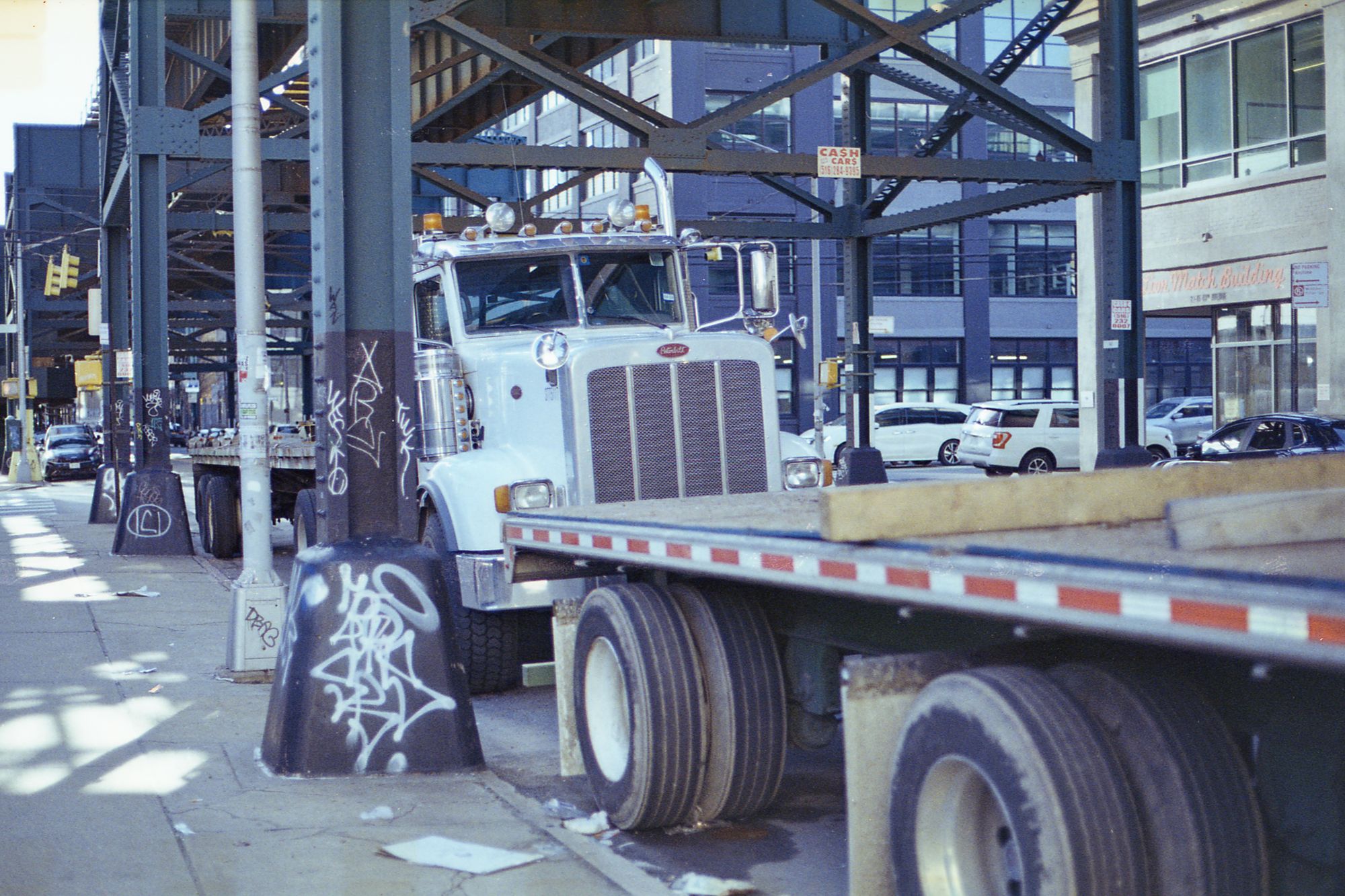
An American conventional semi-truck on a US highway transporting industrial freight
Over-dimensional convoy — US interstate corridor
Common Questions

Questions heavy-haul shippers ask us.

When do I need an oversize permit for an industrial shipment?
Any load exceeding 8’6″ (102 inches) wide, 13’6″ tall, 53 feet of trailer length, or 80,000 lb gross vehicle weight needs an oversize or overweight permit for each state or province it crosses. Loads above roughly 120,000 lb gross are typically classified as super loads, which require engineering route surveys, extended lead times and often police escorts.
What is the difference between an RGN and a double-drop trailer?
An RGN (removable gooseneck) has a detachable neck that lowers to ground level so equipment can be driven or rolled onto the deck without a ramp. A double-drop (also called a lowboy) has a fixed gooseneck and a well between the axle groups that sits very close to the ground, giving a low deck height for tall cargo. RGNs are preferred for self-propelled machinery; double-drops for fixed equipment where deck height clearance is the primary concern.
How far in advance do I need to book a project cargo move?
Lead time depends on load dimensions and corridor complexity. A straightforward oversize move in a single state can be arranged in 3–5 business days once dimensions are confirmed. Multi-state super loads with bridge surveys and utility coordination typically need 3–6 weeks. Wind turbine component or transformer moves on restricted corridors can require 8–12 weeks. Earlier is always better — permit windows are date-specific and can’t always be moved.
Do you handle oilfield logistics including frac equipment and pressure vessels?
Yes. Qeep moves frac pumps, blowout preventers, pressure vessels, coiled tubing units and drilling rigs across North America, including cross-border moves between the US and Canada. We coordinate rig-move sequences, multi-load convoys and temporary traffic control on lease roads. Our oilfield desk operates 24/7 during active drilling campaigns.
Can you transport renewable energy components like wind turbine blades?
Yes. Wind turbine blades exceeding 70 metres require extendable transport trailers (typically a Goldhofer or Scheuerle platform with an active steering dolly), night-only travel windows on many state corridors, and vegetation trimming along some rural segments. We coordinate the full scope including blade curvature road-clearance analysis and utility arm coordination at intersections.
What happens if a permit is denied or a route is blocked?
We maintain alternative routing options for every major project corridor and file contingency permits in parallel when a primary route is uncertain. If a route is denied after filing, we immediately engage the permitting authority for a variance or identify the nearest viable alternative and re-file. Our project managers carry 24/7 contact details for state oversize permit offices in all major corridors.
Let’s move it

Have a shipment? Get rates in 10 min.

Tell us the origin, destination and mode. A Qeep specialist replies within 10 minutes with live capacity, lane price, and a transit window you can actually plan around.