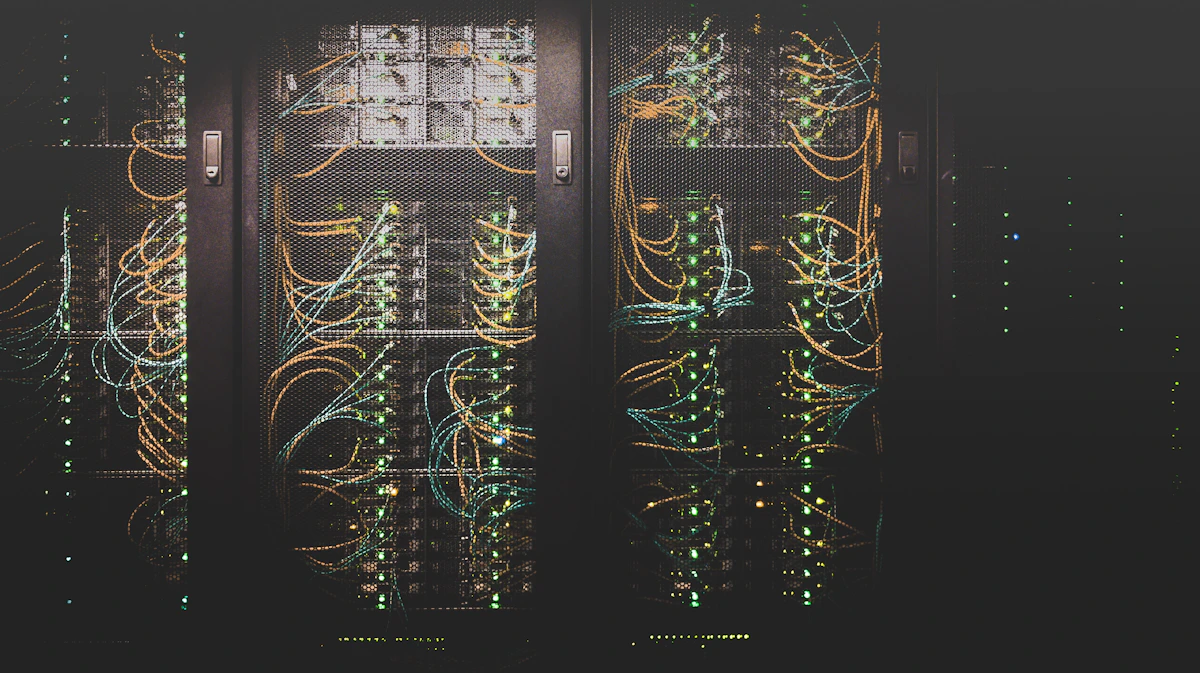
High-Value Freight.
Zero ESD Events.
$5M Coverage.
A dropped server rack or an ESD event on a $2M semiconductor shipment is not a carrier claim — it’s a program delay measured in quarters. Qeep handles technology freight like the load it actually is.
Four layers every high-value
electronics load rides behind.
Standard carrier liability covers $0.25/lb — roughly $22,500 on a full truckload worth $3–5M in GPUs. Qeep runs a four-layer security protocol on every technology shipment, regardless of declared value.
GPS Door-Seal Tracking
Tamper-evident electronic door seals log every open/close event with GPS coordinates and timestamps. Any mid-transit access triggers an immediate alert to your security team and our 24/7 load-watch line.
Team-Driver Assignment
Loads exceeding $500K in declared value are assigned background-cleared team drivers. No solo drivers. No unsecured overnight stops. Continuous movement from origin to delivery.
Up to $5M Declared-Value Cargo
All-risk cargo insurance with declared-value coverage up to $5 million per shipment. Covers theft, physical damage, ESD events documented during handling, and transit delay. Certificates issued same-day.
ESD / ANSI-ESD S20.20 Handling
Facilities certified to ANSI/ESD S20.20. Anti-static flooring, grounded workstations, ionizing blowers, and wrist straps at every pack and unpack station. ESD packaging inspected on inbound receipt.
We don't just deliver to the dock.
We rack it.
Our white-glove desk pre-coordinates with your IT facilities team — delivery window, building access, elevator reservations, dock assignments, and in-row placement. Delivering teams use server-rack dollies and anti-static mats. A signed chain-of-custody receipt from the IT site lead closes every job.
Five challenges that break
generalist freight brokers.
Extreme Per-Unit Value Creating Theft & Damage Exposure
Consumer electronics and semiconductors rank among the most frequently targeted commodities in cargo theft. A single 53-foot van of graphics processing units (GPUs) or CPUs can carry $3–5 million in market value. Standard carrier liability at $0.25/lb covers roughly $22,500 on a 90,000-lb truck — a fraction of 1% of the actual exposure. Security-cleared drivers, GPS trailer monitoring, and declared-value insurance are non-negotiable.
Electrostatic Discharge (ESD) Risk During Handling
CMOS semiconductors, SSDs, and certain PCBs can be permanently damaged by as little as 100 volts of static discharge — invisible to the handler and undetectable until the device fails in the field. Generic warehouse and drayage environments are not equipped with ESD flooring, anti-static workstations, or ionizing blowers. Improperly handled components may pass initial QC but fail early in the field, triggering costly warranty returns and reputational damage.
White-Glove Installation Coordination
Data center hardware deployments require more than drop-off at a loading dock. Server racks must be placed in precise locations, cabled, and often powered-on and racked by the delivering team under IT staff supervision. Scheduling delivery teams with IT windows, coordinating elevator access in high-security facilities, and ensuring no ESD or physical damage during the in-building move require a logistics partner with a dedicated installation desk.
Export Administration Regulations & TAA Compliance
Technology products subject to the Export Administration Regulations (EAR) require Export Control Classification Number (ECCN) screening before export. Federal IT procurement must also comply with the Trade Agreements Act (TAA), which restricts country-of-origin to WTO-GPA qualifying nations. Misclassifying a load or shipping to a restricted end-user without a license exposes the shipper to criminal penalties and debarment from federal contracts.
Time-Critical Supply Chain Dependencies
A delayed shipment of networking switches can hold up a $50M data center commissioning. Late delivery of semiconductors to a contract manufacturer can shut down an entire production line. Technology supply chains operate on hours, not days. Standard LTL transit times of 4–7 days are unacceptable for most critical-path moves in this vertical.
Five capabilities. One specialist desk.
- 01
1. Security-Cleared, High-Value Carrier Assignment
Every high-value technology load is tendered to pre-vetted carriers whose drivers carry current background clearances and who operate GPS-monitored trailers with door-seal tracking. Shipments over $500K in declared value are assigned team drivers and are not permitted to stop in unsecured lots overnight. Real-time GPS coordinates are shared with the shipper’s security team.
- 02
2. ESD-Safe Handling & Facility Standards
Our technology-certified warehouse and cross-dock facilities maintain ESD flooring, anti-static workstations, ionizing blowers, and grounding wrist straps at all pack and unpack stations. Handlers are trained to ANSI/ESD S20.20 standards. ESD-safe packaging is verified on inbound receipt and replaced if compromised before any re-handling.
- 03
3. Declared-Value Cargo Insurance Up to $5M Per Load
We broker all-risk cargo insurance with declared value coverage up to $5 million per shipment for electronics and semiconductor loads. The policy covers theft (including organized cargo theft rings), physical damage, ESD events documented during handling, and transit delay resulting in commodity loss. Certificates of insurance are issued same-day for each load.
- 04
4. White-Glove Delivery & Installation Coordination
Our white-glove desk pre-coordinates with the receiver’s IT facilities team: delivery window, building access, elevator reservations, loading-dock assignments, and in-room placement requirements. Delivering teams use equipment sliders, server-rack dollies, and anti-static mats for final placement. Post-delivery chain-of-custody documentation is signed by the IT site lead.
- 05
5. Export Control & TAA Compliance Screening
For cross-border and international technology moves, our compliance desk screens every shipment against the EAR Commerce Control List, validates ECCN classifications, checks end-users against the Denied Persons and Entity Lists, and confirms TAA country-of-origin compliance for federal-bound shipments. We maintain export licenses on file for commonly shipped controlled commodities.
Every connection in your network depends on every component arriving intact, charged, and on schedule.
The regulations our desk speaks
fluently — EAR, TAA, ESD S20.20, C-TPAT.
EAR — Export Administration Regulations
The EAR (15 CFR Parts 730–774) controls the export of dual-use technology, including semiconductors, encryption hardware, and advanced networking equipment. Shipments require ECCN classification, end-user screening, and in some cases an export license. Violations carry civil penalties up to $307,922 per violation and criminal penalties up to $1M and 20 years imprisonment.
TAA — Trade Agreements Act
Federal IT procurement under GSA schedules and DoD contracts must use products manufactured in TAA-designated countries. Qeep verifies country-of-origin documentation for technology freight destined for federal agencies and flags non-compliant shipments before they reach a government receiving dock.
ANSI/ESD S20.20 — ESD Control Program Standard
The ANSI/ESD S20.20 standard defines the requirements for an electrostatic discharge control program in facilities handling ESD-sensitive components. Our technology-handling facilities are certified to this standard, with documented equipment calibration records and annual third-party audits.
C-TPAT — Customs-Trade Partnership Against Terrorism
High-value electronics crossing the Canada–US or Mexico–US border require C-TPAT-validated carriers to qualify for expedited CBP clearance and reduce the risk of exam delays. All Qeep cross-border carriers in the technology program are C-TPAT certified, reducing average border dwell time by 60%.
FMCSA Cargo Securement (49 CFR 393.100–136)
Electronic equipment in racks and cabinets requires custom blocking and bracing to prevent damage from road vibration and driver maneuvers. Our technology-trained drivers use air-ride trailers, custom cribbing, and load-brace configurations reviewed by our engineering team for each data-center hardware move.
The freight modes technology shippers depend on.
Expedited
Time-critical freight — sprinter, straight-truck and team-driver expedites with under-hour cover.
Full Truckload (FTL)
Dedicated trailer, single shipper, point-to-point — fastest transit and full chain-of-custody.
Warehousing
Bonded and ambient warehousing, pick-and-pack, B2B and DTC fulfillment with WMS visibility.
Questions technology shippers ask us.
How do you protect against cargo theft on high-value electronics shipments?
What does ESD-safe handling actually mean in practice?
Can you coordinate white-glove delivery into a high-security data center?
Do you handle export-controlled technology shipments?
What cargo insurance options are available for semiconductor loads?
How fast can you respond to a critical-path expedite for technology freight?
Adjacent verticals we serve.
Aerospace & Defense
AOG response, MRO logistics, ITAR-aware handling and certified DG transport.
Government & Defense
Federal, state and provincial agencies, defense contractors — cleared transport with audit trails.
E-commerce & DTC
Fulfillment, DC bypass, omnichannel, last-mile and returns — built for the SKU-heavy DTC stack.
Have a shipment? Get rates in 10 min.
Tell us the origin, destination and mode. A Qeep specialist replies within 10 minutes with live capacity, lane price, and a transit window you can actually plan around.